Permaculture comes from the Latin words ‘Permanens’, to persist indefinitely and ‘cultura’ the cultivation of land/intellect, now understood as the practices that support human societies. These words together mean a persistent system that supports human existence.
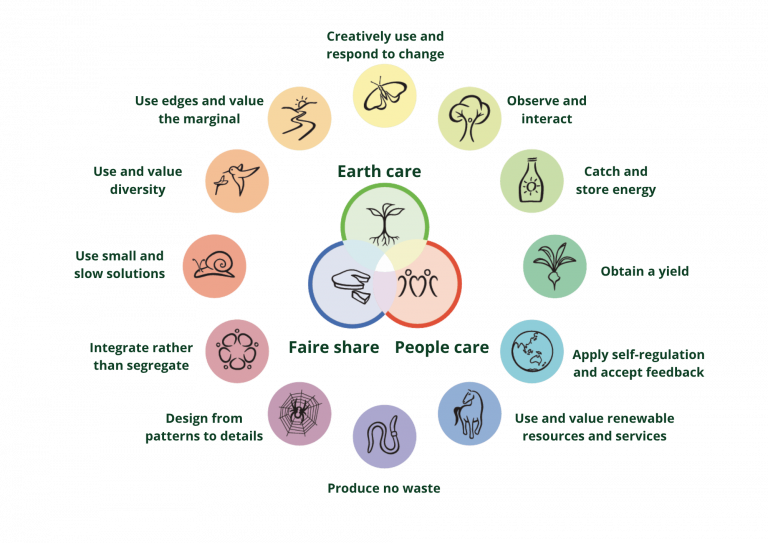
Permaculture is a design process that tries to mimic the patterns and relationships that we find in nature in order to build a resilient ecosystem. It is based on 3 ethics and 12 principles. We already went deeper into the 3 ethics of permaculture and will now go briefly into the principles.
Permaculture Design Course
David Holmgren is the co-originator of the permaculture concept, alongside Bill Mollison. Together they stood at the foundation of this movement. To teach others on the topic, they developed the 72-hour Permaculture Design Course (PDC), which is nowadays taught all over the world. Roos followed the course and got her PDC-certificate in 2023.
Although the teaching format is the same in every PDC-course, if you look for information you will find some slight variations in name, order or details when it comes to the principles. We use the outline of David Holmgren, which can be found in ‘Essence of Permaculture’ (revised edition 2020). You can download it for free at his website, we put the link on the bottom of this blog.
12 principes
Holmgren on principles: “Permaculture principles are brief statements or slogans that can be remembered as a checklist when considering the inevitably complex options for designing ecological support systems. These principles are universal, but the methods that express them will vary greatly according to place and situation.”
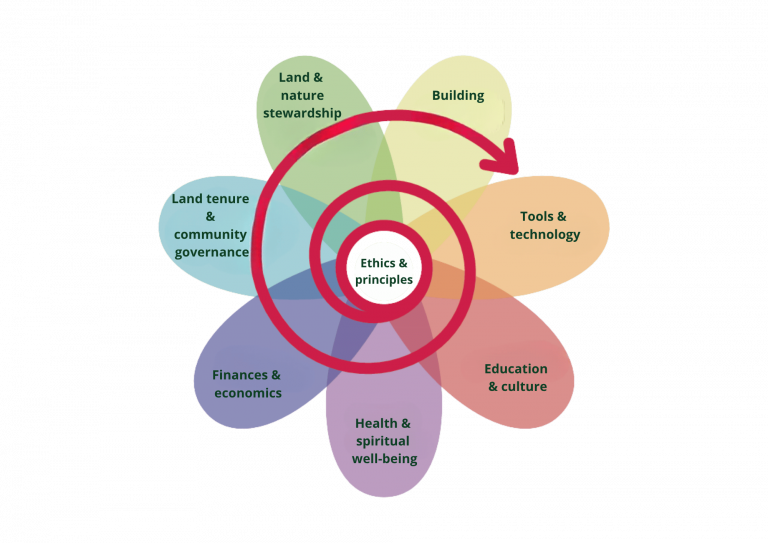
In ‘Essence of permaculture’, Holmgren uses a flower to show how the ethics and principles are also relevant to other fields. He writes: “they are also applicable to personal, economic, social and political reorganization, (…) although the range of strategies and techniques that reflect the principles in each domain is still evolving”
It is, you could say, the more elaborated ‘permaculture bookcase’ that you find on our page about the garden and permaculture. As he mentions, this domain is still evolving. We had some nice discussions about the different things you find in the flower, and whether we thought it was compatible with our permaculture vision.
Do you want to learn more? We organize two workshops on permaculture in 2026! Join us for a weekend of discovery and relaxation in the beautiful Vosges mountains. The planned workshops are in French, for a group of 4-6 persons, we can organize the weekend in English on request.