
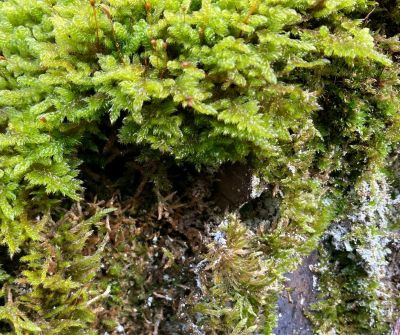
Mosses were among the first beings to emerge on bare continents 500 million years ago. To be able to do so, they evolved to survive extreme environments. Scientists simulated in computer models they should even be able to survive few days in space or on Mars.
They stretched it, in real life condition, by hanging a moss, Physcomitrium patens, outside the International Space Station for nine months. It was exposed to vacuum, freezing cold, and UV rays, and once back inside, its spores not only survived but retained their ability to reproduce!
Bryophytes
During evolution, organisms moved from an aquatic environment to a terrestrial environment. Terrestrial environments are more hostile than aquatic environments due to factors such as drying out, ultraviolet (UV) radiation, and temperature variability. Bryophytes (a group that includes mosses) were the first organisms to adapt to these terrestrial conditions, making them one of the most resistant species to environmental change and allowing them to survive to this day. About 500 million years ago, bryophytes colonized the soil and formed the basis of the terrestrial ecosystem. Since then, bryophytes have survived despite deep environmental changes on Earth, such as mass extinctions.
Resistance of moss
Another example of the incredible resistance of moss was discovered during an expedition to Antarctica in 2003. Researchers collected a sample of Chorisodontium aciphyllum moss from a depth of 110 cm that was still alive. It was radio-carbon dated to between 1533 and 1697, which represents an absolute record for preservation time we could observe in the plant kingdom. However the researchers think that given the good structural preservation, it has the potential for even longer periods of viability.
Symbiosis
You have probably already experienced this: when you re-moisten moss that has dried out, it revives and resumes its life as if nothing had happened. This is because, contrary to vascular plants, most of moss water is “external”, meaning running on the surface. As moss doesn’t have roots, it absorbs water through direct contact. Thus, it is less affected by desiccating (drying out) and freezing. It absorbs mostly the nutrients brought by invertebrates and rain water. But not only. And this is the most fascinating part. Vascular plants live in symbiosis with fungi, which grows in their roots. The fungi brings micro-nutrients to the plant in exchange of glucose produced by the plant. This symbiosis is called mycorrhizae. This way the plant has access to nutrients it would be able to reach otherwise.
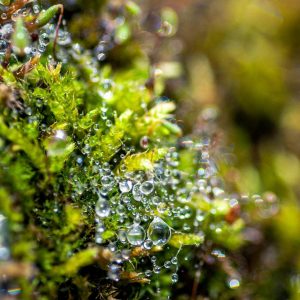
Even in the absence of roots, mosses benefits of a similar symbiosis with fungi. A lot is still to be discovered in this area but from the few studies realised so far, we understand it can be important.
Tripartite symbiosis
For instance, in boreal forest mosses can live on frozen ground all year long. Fungi help them to get nutrients. The most interesting case can probably be found in the boreal ecosytem associating crooked pines with mosses of the hypnaceous type.
The fungi’s mycellium colonises both the trees roots and the mosses. A moss releases some phosphorus and nitrogen, and when it dries out, it can be in significant amounts. These nutrients, which are essential for plant growth, are supposed to be washed away by rainwater. But researchers observed that the phosphorus and carbon previously incorporated into the moss stems are absorbed by the mycorrhizal mycelium and transferred over distances of several centimeters to the colonized roots of the pine plants and subsequently to their stems.
Is this an altruistic gesture on the part of the mycelium to avoid wasting nutrients? No. When the moss dies, it releases glucose, fructose, and sucrose in sufficient quantities to allow the fungi to grow.
It is a marvelous example of a symbiosis involving three different beings (we usually know relations between two). It shows also how cooperation prevails in nature when resources are scarce like in boreal latitudes.
I will introduce you to many stories about living things when you take part in a Deep Time Walk.
Sources:
Maeng, Chang-hyun et al. , Extreme environmental tolerance and space survivability of the moss, Physcomitrium patens iScience, Volume 0, Issue 0, 113827,
Esme Roads, Royce E. Longton, Peter Convey, Millennial timescale regeneration in a moss from Antarctica, Current Biology, Volume 24, Issue 6, 2014, Pages R222-R223, ISSN 0960-9822, https://doi.org/10.1016/j.cub.2014.01.053.
J. Carleton and D. J. Read. 1991. Ectomycorrhizas and nutrient transfer in conifer – feather moss ecosystems. Canadian Journal of Botany. 69(4): 778-785. https://doi.org/10.1139/b91-101