
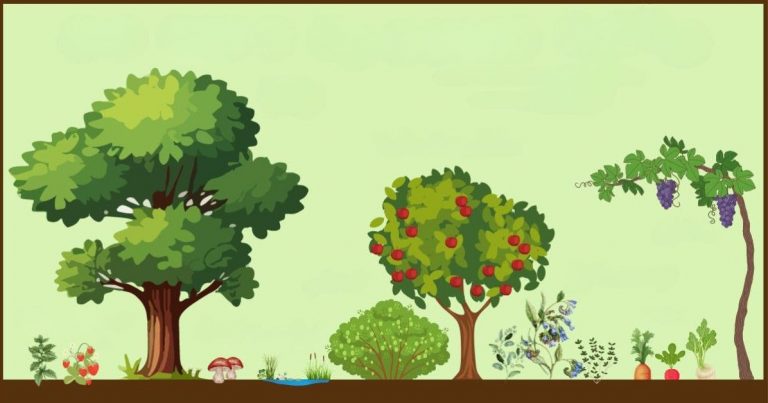
A food forest, or forest garden, mimics a young forest using various, mainly edible plants in multiple layers. These layers fall generally under 7 categories: large trees (>5m), small trees (2-5m), shrubs, herbaceous perennials, climbers, root crops and ground cover. Annual vegetables and herbs can also be part of it. It is planted in such a way that plants benefit from each other in a long-term resilient ecosystem.
In our garden in Maisonsgoutte, we dedicated about 3000m2 to the food forest. It was mainly grassland, with a walnut tree in the middle. On the north side some existing forest trees and brambles forming a natural barrier.
Here we will tell you how we started off the food forest and used the feedback loops that are so important in permaculture design.
Year 1
In 2024 we made a full design of the canopy layer. Our thinking was to plant layer by layer the entire 3000m2. Starting with the large trees (canopy), then the following years planting the small trees, bushes etc. We were eager to begin, as they say: “The best time to plant a tree was 20 years ago. The second best time is now “. In winter we planted the canopy layer, a couple of small fruit trees, a supporting tree (nitrogen fixating tree) and the hedge on the southern side. The hedge functions as a wind breaker and as a natural barrier.
Feedback loop
In spring and summer, we saw the mistake we made. We did not plant pioneer trees. With the hedge still low and the land too open, the young trees needed more shelter from wind and sun and some struggled to stay alive and thrive. Pioneer trees, like birches and Siberian pea trees, prepare the ground and as they grow fast they can protect young trees. They can be cut later to make room for others.
Budget was also something we increasingly got aware of. Trees and bushes don’t come cheap. We face a 10% failure rate, which is quite low and means we do a good job at planting but over 200 trees, it has still an impact. Considering we love to plant some special species aiming for high diversity, we do not buy necessarily the cheapest. Even if we propagate the bushes ourselves and our parents and other people are generous, planting 3000 m² of a dense food forest with multiple layers requires money.
Year 2
This year we started with reflecting on the feedback. We also had more time to dive deeper into the subject and Julien visited a food forest festival (Festival des jardins-forêts, Belgium). He came back with trees and lots of inspiration. This together resulted in:
- buying pioneer trees to make the forest denser and protect the young trees;
- dividing the 3000m2 into sections and plant all layers section by section instead of layer by layer on the entire surface.
- the need to find additional funding for the food forest;
- and our view on what kind of food forest we want to design.
A food forest is called a food forest if it has at least 45 different varieties. We can divide them into two groups : productive food forests and romantic food forests. A productive food forest works with rows in order to make harvest easy and usually focuses on species with a market value. A romantic food forest can contain a lot of different (less well-known) species and does not work with easy to harvest rows of plants. We are a bit in between these two ideas: romantic but practical. We want to be able to harvest, and this means that all fruit bearing trees and bushes are accessible and lower layers like the ground cover will be adapted to this.
The first section
Working with sections allows us to fully enable feedback loops over time and it will give plants immediate protection within their section. We start with a small plot of about 80m2 in the lower part of the area. It is not an easy plot: dry and rocky. We prepare it by placing a thick layer of hay from other part of the land to kill the grass.
At the same time we worked on the detailed design. We used the book of Martin Crawford ‘Creating a forest garden, working with nature to grow edible crops’ and the ‘Caragana kit jardin agro-forestier’ from Les Alvéoles. Also, discussing with others in the food forest community and visiting already functioning forest gardens helped a lot to shape our design.
Year 3 and beyond
Each year we will implement another section. We apply the lessons and feedback of the land from previous years to design the next stage. In about 6-8 years the food forest is completely planted, with each section in synergy with the others. This will probably not be within initial budget, but that’s a small price to pay for so much abundance and variety.