
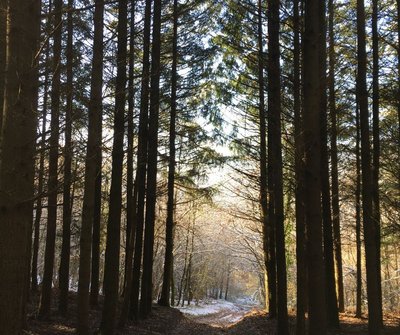
When we got married my sister gave us a book: Breading Sweetgrass of Robin Wall Kimmerer. It is a collection of beautiful stories and I was immediately captured by it. Robin Wall Kimmerer descends from an indigenous tribe in the United States and she tells about the strong connection with Nature of the indigenous people.
Embrace the wolf
While reading this book I came across a recent study on human-nature connectedness in 61 countries. My mother country, The Netherlands, is in the bottom of this list. No wonder: after an absence of 150 years we welcomed the wolf back by trying to get rid of it again as soon as possible. In a country like the Netherlands, with scattered small pieces of nature, there is no room for the wolf, says politicians, farmers and some citizens.
The study mentions that promoting stronger human-nature connectedness is likely to be a powerful strategy for the transformative change required to address the environmental crises. But how do we do this? How do we embrace the ‘Wolf’ when governments, companies and some people still find it hard to consider that our well-being strongly depends upon the health of the natural world.

Human–nature connectedness (HNC) as a pathway to sustainability
In the study “Human–nature connectedness as a pathway to sustainability: A global meta-analysis” the HNC is defined as the extent to which humans see themselves as part of nature. The American ecologist Aldo Leopold says about it: “We abuse land because we regard it as a commodity belonging to us. When we see land as a community to which we belong, we may begin to use it with love and respect”
A possible explanation of why we see ourselves as less part of nature, can be found in the rapid urbanization. More than 55% of people nowadays live in urban areas and have less access to natural environments. Living in an urban area myself for a long time, I had the pleasure to have a forest nearby. On Saturdays I went at 06:00 for a walk, because by the time it was 08:00 it was full of bootcamp groups. I remember that hearing somebody shout ‘Another 10 burpy’s, come on!’ was not helping my connectedness to nature.
How to enhance HNC?
The analysis show that: “ the extent to which people feel part of nature can be enhanced by simple interventions involving contact with nature and mindfulness practices, (…) it can be a valuable way to help individuals to understand and experience how much human welfare and nature conservation are interconnected.”
Can it be this simple? The analysis goes on: “surprisingly, we found little impact of environmental education on HNC, and we assume that this is due to the traditional anthropocentric, “rational” transmission of scientific knowledge, which has delegitimized and suppressed its emotional content.”
Okay, so to enhance HNC we need to have real contact with nature and mindfulness practices. And we need education and scientific knowledge in a less traditional non-suppressing emotional way. I know the perfect tool for that.
Deep Time Walk
A Deep Time Walk is a 4.6 km storytelling walk to travel through the 4.6 billion years of Earth’s history and relive, step by step, each significant event in the emergence and evolution of life on Earth. It combines a poetic, meditative experience with interesting and important scientific facts about our planet. Julien guides this walk in the peaceful landscape between Maisonsgoutte and Breitenbach (never encountered any bootcamp group here).
We also start our Weekend stage Permaculture with the Deep Time Walk. And this is not by accident. Because for me, Permaculture embodies an emotional bond with Nature, with Gaia, combined with profound scientific knowledge on how to take care of her. And to take care of us, of course, and share what we have.